
Thursday Throwback
Revisiting my university blog reviews

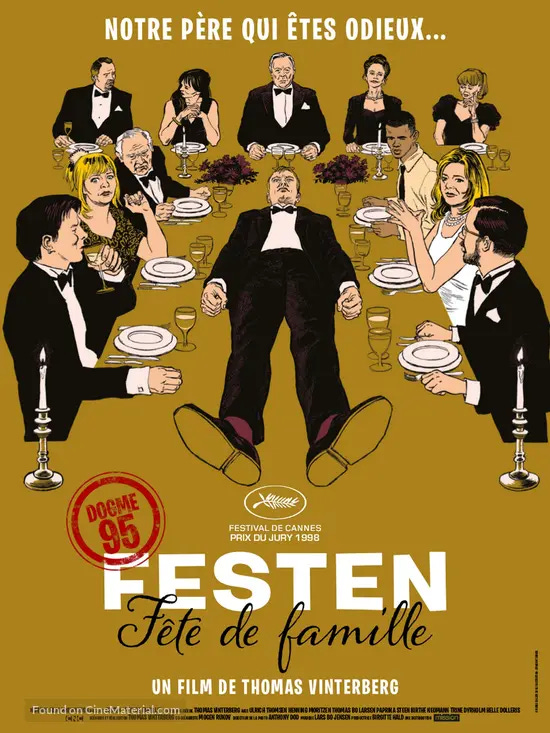
During the early 1990s Thomas Vinterberg was on a roll. His graduation short film for The National Film School of Denmark was praised across the country. Perhaps most significant was his friendship with fellow budding director Lars von Trier, whose early work also showed promise.
In 1995 they founded an organisation that officially eschewed personal film-making tastes for collective ones. DOGMA95 was announced with a grandly tongue-in-cheek manifesto and ten-point ‘Vow of Chastity’. These demanded a sparse directorial style free of ‘bourgeois romanticism‘. Two years later Vinterberg created (anonymously. Rule ten: the director must be un-credited) the first DOGMA film.
Festen may be the most effective expression of DOGMA’s rules. It was certainly their most successful film internationally. Here Vinterberg stays true both to his own commandments and their ideology.
In it a family gathers to celebrate its patriarch’s 60th birthday at a hotel he owns. During a luncheon speech the man’s eldest son Christian (Ulrich Thomsen) quietly states that he and two siblings were repeatedly raped by their father as children.
DOGMA rules one and seven (shooting must occur on location and with temporal fidelity to the story) are well-applied in supporting the build-up to this revelation and its consequences. The film opens with Christian walking alone along an open country road, incongruously wearing a suit. It immediately gives a sense of separation and detachment to this character that is developed throughout the film.
Events darken with the day. Settings constrict to small rooms, narrow spaces and a thickly wooded area at dusk. The family become trapped both physically and psychologically in a nightmare situation.
Place and time of day are two of the means by which Vinterburg fulfils his stated aim ’to force the truth out of my characters and settings’. As Christian falls victim to abuse and denial by his family, sound – rule two: sound must never be produced apart from the images or vice versa – adds to the violent and repressive atmosphere. Footsteps and voices thud against floorboards and walls, chill silences are pierced by clinking cutlery and dripping taps. Organic as they are, their effect is exaggerated by enclosure.
Camerawork also plays a significant part in confining the characters and disorienting the audience. Every camera had to be hand-held so cast-members often doubled as camera operators during scenes. This results in frequent close-ups of faces and significant objects. Perspective is turned into a prying eye amongst uncomfortably close people.
The images though are slightly fuzzy, a product of using early digital video. Their colours are almost uniformly muted. These two features metaphorically reflect the character’s moral ambiguity. Most of them are in a void and behave inconsistently. The audience may see more than each individual but it is equally in the dark about what will happen next. What is clear by the end, however, is that the illusion of respectable family cohesion has been thoroughly dismantled.
Vinterburg’s international debut shows individuals both conforming to and defying their social group. The members of DOGMA eventually outgrew their own organisation. In 2002 it was disbanded for becoming a generic style in itself. Its legacy was helping to make experimental, low-budget short productions part of film culture again.
As for Vinterburg and von Trier, their career paths diverged. The latter became an established if unpredictable presence in Hollywood, before retiring into care in 2025 with Parkinson’s disease. Vinterburg’s profile has been lower, with his output since Festen considered hit-and-miss. His breakthrough however put both him and Danish film-making on the map.