Thursday Throwback
Revisiting my university blog reviews

Victoria Wood made a significant niche for herself writing tragi-comic TV dramas about lonely, disappointed people. That Day We Sang is in that vein, the only difference being that the main characters burst into song every few minutes.
Like her previous stories Housewife, 49 and Loving Miss Hatto, this one has an interesting true-life basis. In 1929 Colombia made a recording of Purcell’s Nymphs and Shepherds with the Manchester Children’s Choir and the Halle Orchestra. A generation later former choir members recalled that day for a TV documentary. Wood’s version of these events makes good use of her Lancashire roots and puts her musical streak literally centre-stage.
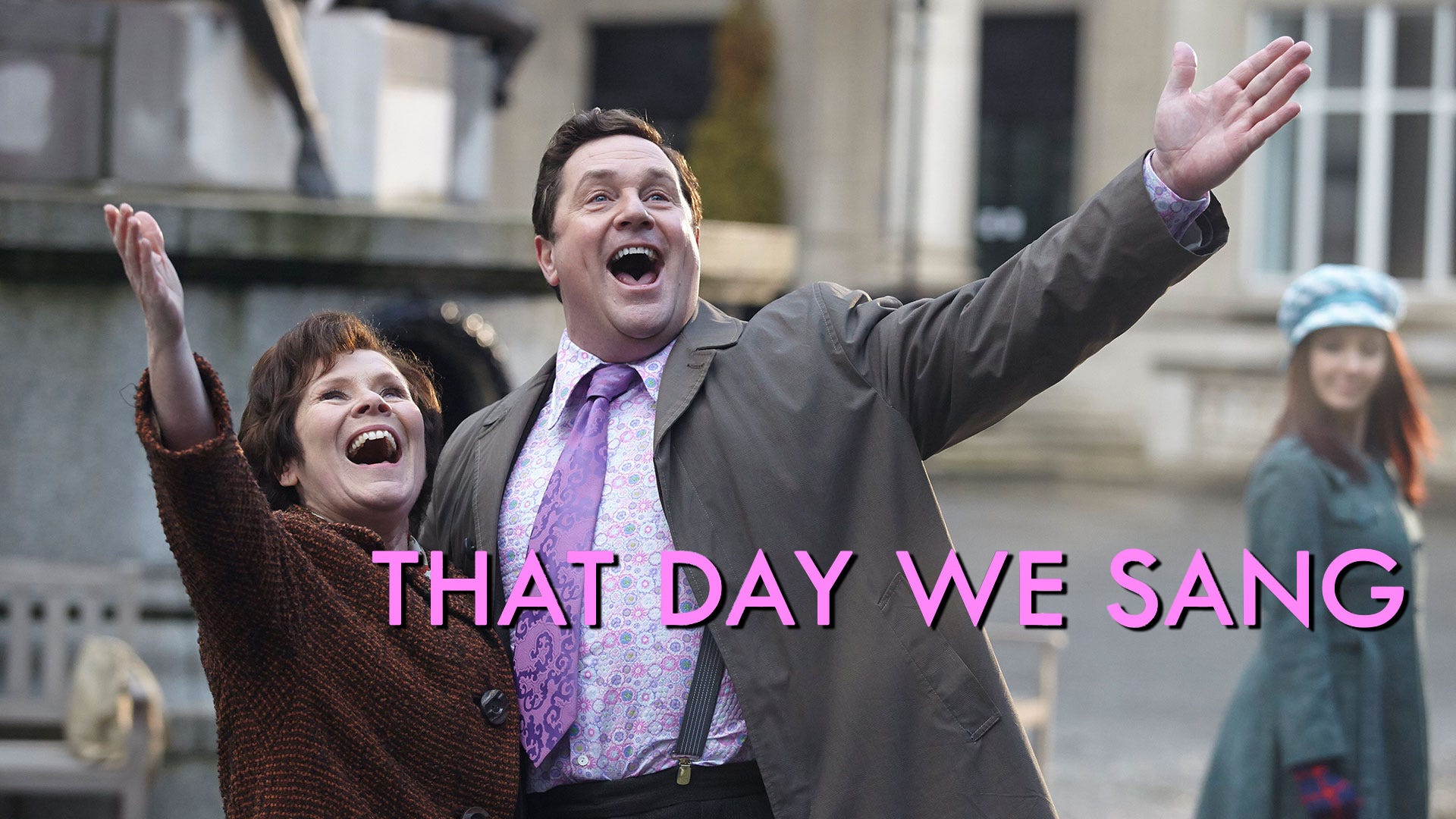
That Day We Sang revolves around middle-aged Tubby (Michael Ball) and Enid (Imelda Staunton), who meet again during interviews for the documentary. Their stumbling romance is the conduit for Wood’s down-to-earth humour and sympathy for quiet-living, anonymous folk.
Adapted from her stage play with music, originally performed in Manchester’s Opera House, stylised flights of fancy colour the characters’ humdrum outer lives. It’s easy to imagine many of the scenes taking place on a stage. Two very real places though are centrepieces to several key scenes – Manchester’s Free Trade Hall and Liverpool’s Exchange Flags square.
The basic plot is added to more than driven by music, although this carries the main theme of expression and connection. The songs are warm and simple, strongest in the lyrics. These, couched in the everyday, determinedly give words and colour to the mute greyness of missed opportunities – or those that may be missed if you don’t ‘just blitherin’ DO IT!’.
‘you play it save never rock the boat. Then you have a choice for winter or for spring to find your voice and sing’
With bang-on accuracy they point out how lives can get bogged down:
‘I am clear on the fear that has led to where I am now.’
The first song, Did I Sing?, exactly matches my own slight incredulity at having once been in a school choir.
‘Was that me? Did I sing? Did my voice once soar?’
Along with the quick-fire dialogue, the film format contributes to a fast pace. Action can move quickly between a range of locations – buses, trams, offices, homes, streets, cafes and a restaurant. It is best used, though, when camera angles gently linger on a character’s face as emotions pass through them. It is at these silent moments that the story is subtlest.
Often Tubby shares scenes with his young self Jimmy Baker (Harvey Chaisty) as he looks back on his choir days. This doesn’t always feel quite right visually. Seeing them sing to each other seems too contrived and unrealistic. Coincidence is strained a bit further when multiple characters happen to work in the same office block and a teacher Jimmy befriended later becomes a doorman there.
Quibbles aside, Harvey Chaisty was a star find. His look and demeanour were perfectly caught by Michael Ball. I’ve never imagined Imelda Staunton as timid (‘scared of life, scared of sheep, scared of thunder’) but she pulled it off enough to be believable along with some lovely singing and dancing. More quietly memorable was Daniel Rigby as Jimmy’s wounded war veteran teacher.
Victoria Wood set out to make a ‘Moulin Rouge with slippers’. Predictably without the nuance of Housewife, 49 and Loving Miss Hatto, That Day We Sang is also without their melancholia. It’s a bright celebration of the bigness in small lives.