
Thursday Throwback
Revisiting my university blog reviews

In 2011 the ultra-Orthodox Jewish enclave of Mea Shearim in Jerusalem erupted in protest. A Gay Pride procession was met with huge crowds both for and against them.
Two years earlier this area played partial host to the debut film of a young secular Israeli director, Haim Tabakman. During filming the crew had stones thrown at them and passers-by told them to leave. Their film split ultra-Orthodox opinion as neatly as the Gay Pride march would.
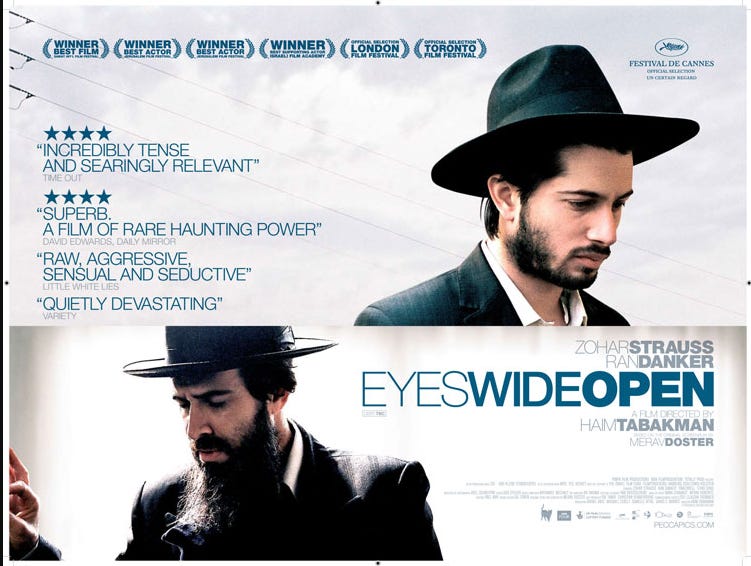
Eyes Wide Open explores with quiet strength a homosexual relationship within an anonymous ultra-Orthodox community. Its uncompromising portrayal of the subject earned it an Un Certain Regard nomination at Cannes.
The film’s opening is highly symbolic as Aaron Fleischman (Zahar Strauss) smashes the lock of the butchers shop recently inherited from his father. Soon after a young stranger arrives seeking shelter and work. Aaron is an established member of the neighbourhood, with a young wife and children. Edzi (Ran Danker) though, an outsider in every way, awakens something dormant in him.
Tabakman’s cinematic tastes are broad but the sparse realism of French New Wave is most obvious here. The simplicity of the settings (a yeshiva, shop and family homes representing the points around which community life revolves) are seemingly matched by the script. Within both however are many complexities.
Through Aaron writer Marev Doster skilfully personalises the fluid and uneasy borders of personal identity and religious faith. Aaron begins as a model ascetic, ‘loving the hardship’ of ‘being a slave to God’. The attraction between him and Edzi becomes the archetypal sin to overcome. Aaron’s eventual acknowledgement of his failure at this (‘I was dead. Now I’m alive.’) characterises the film’s lack of melodrama.
The visual symbolism Tabakman uses throughout is most overt during two scenes at a lake outside the city. This is a place for mikvah, the solitary ritual of cleansing vital in ultra-Orthodox culture. Aaron’s and Edzi’s mutual bathing there early in the film breaks not just ice but a fundamental rule.
Just as significantly, the lake is also the only light and open space in the film. All other scenes occur within dim rooms, narrow streets and on congested roads. Filming was often at night and during downpours. The effect is of a series of boxes, heightening the character’s personal confinement and the social oppression within their hemmed-in culture.
Like walls, cameras are always close to the characters. This creates intimacy as well as claustrophobia. One of the film’s key features is the amount suggested by subtle expressions on actor’s faces. The fact that many scenes were improvised adds to its naturalistic feel.
Much of the film’s power comes from its two leads. There are similarities between the characters and the actors. For Zahar Strauss Aaron’s dilemmas were an acting challenge. Ran Danker meanwhile was keen to be more than a teen heart-throb and singer.
Eyes Wide Open was made on a small budget and short time-scale. However, it made a mark beyond the ultra-Orthodox world. Recently it was re-screened by popular vote at Wesleyan University’s Israeli Film Festival. The film remains Haim Tabakmans’s most widely-known and daring work.
Tabakman has continued making poetic dramas about people’s reactions to outside forces shaping their lives, whether religious or national. Both still affect everyday life in his Israeli home.